- Home >
- Explainers >
- Splunk
Splunk SIEM: Key Features, Limitations and Alternatives
- 9 minutes to read
Table of Contents
What Is Splunk SIEM (Enterprise Security)?
Splunk SIEM, also known as Splunk Enterprise Security (ES), is a security information and event management system offering security monitoring and analysis. It attempts to allow organizations to gain visibility into their IT infrastructure and detect potential security threats.
Splunk ES collects and correlates data across multiple sources, providing somewhat real-time insights into security events. This software identifyies anomalies and responds to them over a period of time, mitigating potential damage.
Unlike traditional security systems, Splunk SIEM offers analytics capabilities and machine learning for threat detection. It simplifies incident response through customizable dashboards and alerts.
This is part of an extensive series of guides about managed services.
Key Features of Splunk SIEM
Splunk Enterprise Security (ES) offers a set of features to improve threat detection, investigation, and response:
- SOC workflows: Integrates SIEM and SOAR workflows, offering an interface for detecting, investigating, and responding to threats. This approach intends to reduce mean time to detect (MTTD) and mean time to respond (MTTR).
- Detection versioning: Attempts to automatically manage and track versions of detection content, to enable updates, rollbacks, and backups. The hope is better detection hygiene and management of security configurations.
- Risk-based alerting (RBA): Prioritizes alerts by attributing risk scores to users and systems, in the hopes of reducing false positives and improving SOC productivity.
- Threat topology: Maps the scope of incidents, linking risk and threat objects for investigation and response.
- Behavioral analytics: Utilizes machine learning to analyze user behavior, detect anomalies, and improve threat detection accuracy.
- Investigation workbench: Contains data, intelligence, and context for incident analysis. It includes timelines and ad-hoc search for investigations.
- Adaptive response actions: Provides automated and manual actions for notable events for remediation and incident handling.
- Threat intelligence integration: Used to augment alerts with internal and external threat intelligence sources when available, which is operationalized through Splunk SOAR.
- MITRE ATT&CK framework support: Enables analysts to correlate incidents with the MITRE ATT&CK Matrix for situational awareness and responses when applicable or available.
- Pre-packaged content updates: Includes updated analytic stories and use cases from the Splunk Threat Research Team.
Related Splunk Security Products
Splunk SOAR (As of Q1 2025)
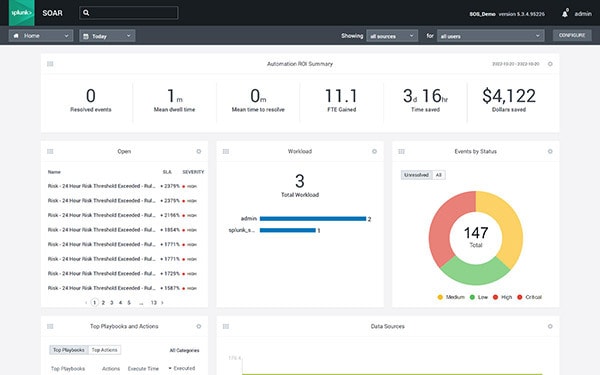
Splunk SOAR (Security Orchestration, Automation, and Response) assists security operations centers (SOCs) by automating tasks and orchestrating workflows across various tools. It integrates with various third-party tools, supporting automated actions to simplify incident response.
With its Visual Playbook Editor, users can create custom workflows, in the hopes of improving scalability and usability. It provides case management, threat intelligence integration, and different deployment options (on-premises, cloud-based, or hybrid). Splunk SOAR also integrates with the MITRE ATT&CK and D3FEND frameworks, offering prebuilt playbooks to automate end-to-end use cases.

Splunk Attack Analyzer
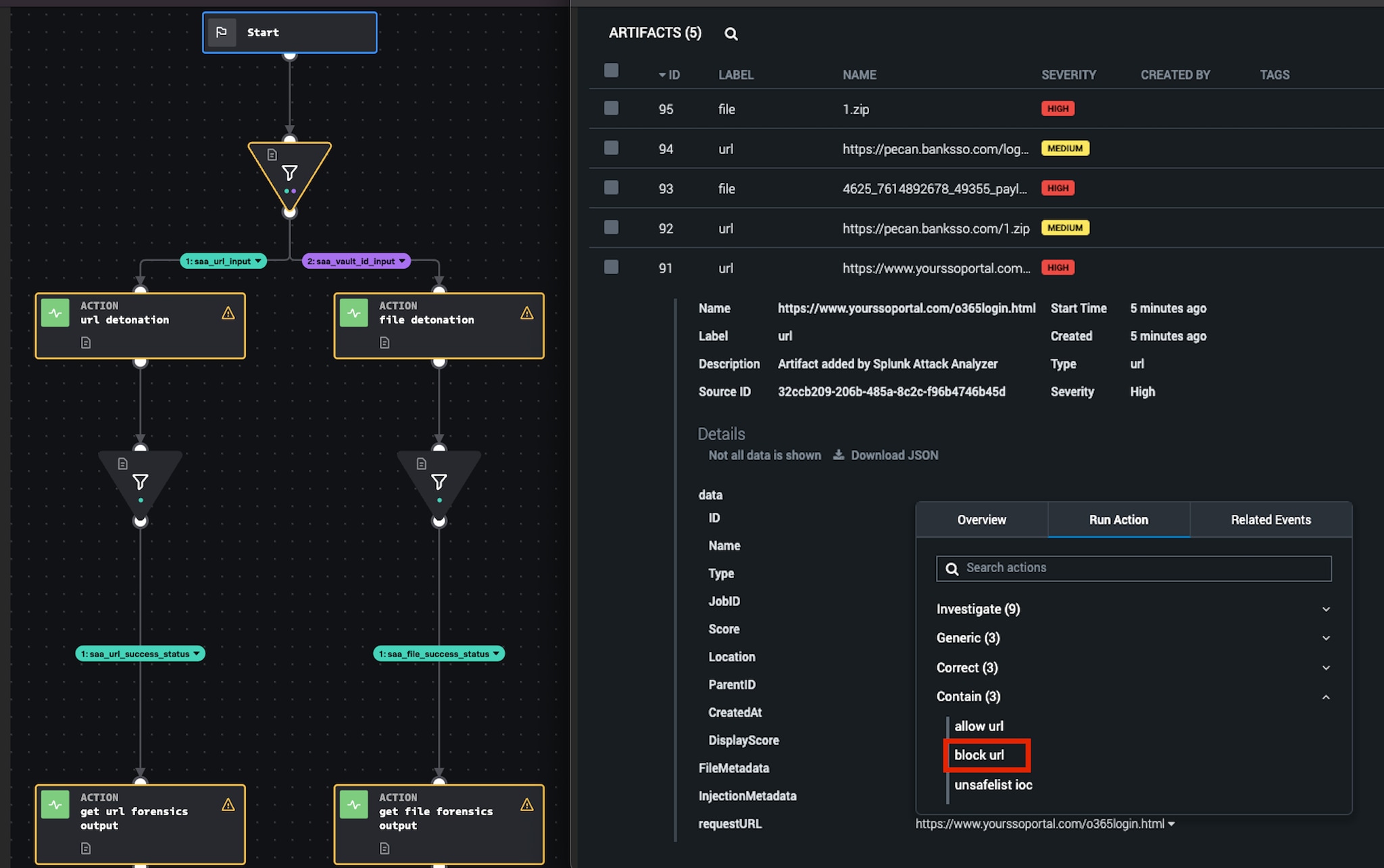
Splunk Attack Analyzer attempts to automate the analysis of active threats, such as malware and credential phishing attempts, to provide insights for response. It’s aim is to execute potential attack chains in a sandbox environment, including accessing links and extracting attachments, giving security teams a forensic view of the threat.
By integrating with Splunk SOAR, the goal is to enable end-to-end automation of threat detection and response workflows. Analysts are intended to interact with malicious content in secure environments and visualize attack chains, for threat investigations, hunting, and operationalize threat intelligence. The tool also offers an API for integrating threat data into other platforms.

Splunk Asset and Risk Intelligence
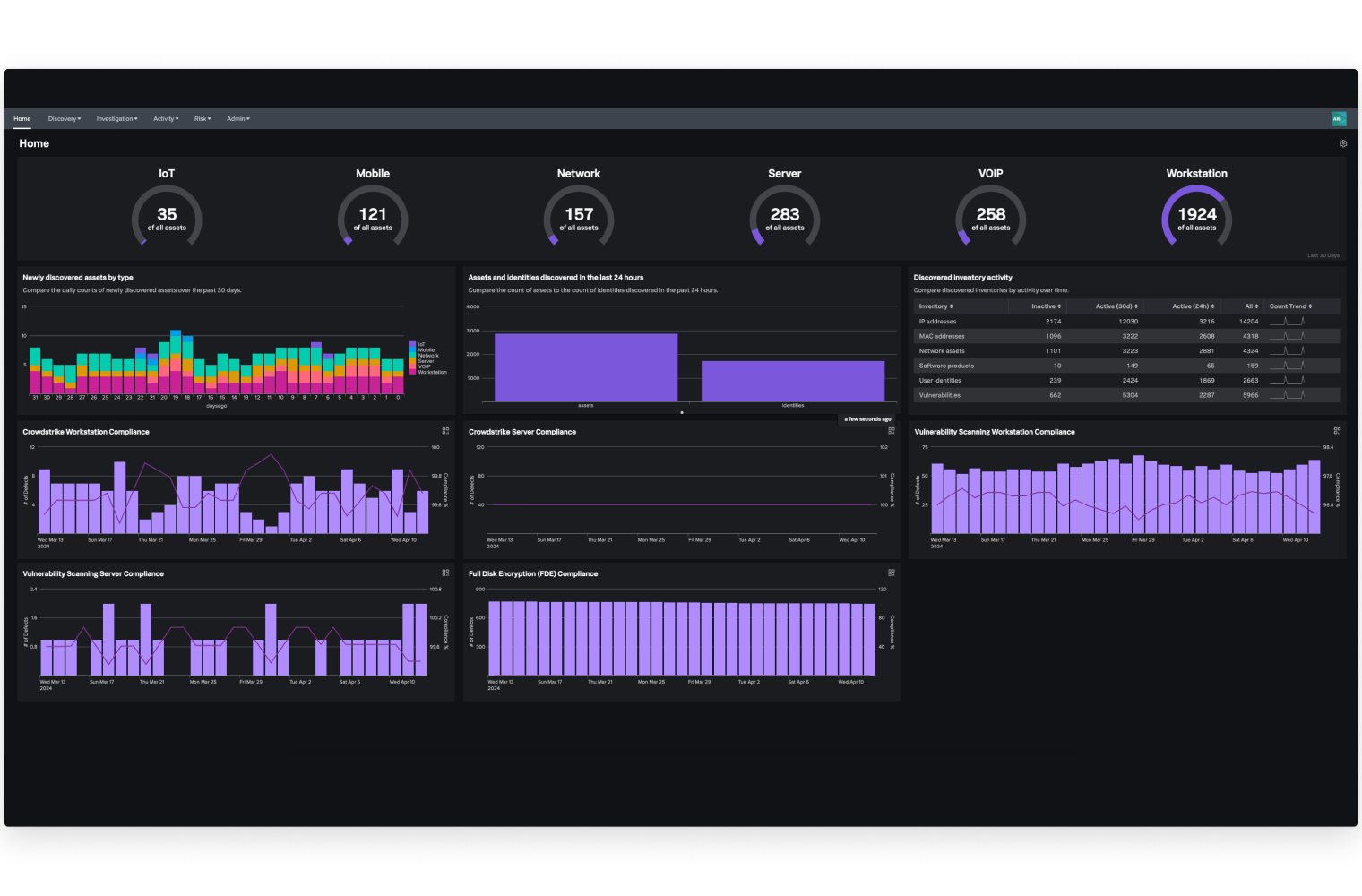
Splunk Asset and Risk Intelligence intends to deliver asset discovery and risk monitoring from network, endpoint, cloud, and scanning tools. This goal is to provide a unified, updated inventory of assets and identities, for visibility across IT and security operations (SecOps).
Security teams can conduct investigations with context on assets and identities while identifying compliance gaps using out-of-the-box dashboards. The tool integrates with Splunk ES for asset data in event investigations and connects with tools like ServiceNow CMDB, in attempt to manage unmanaged devices and improve compliance status.

Splunk User Behavior Analytics
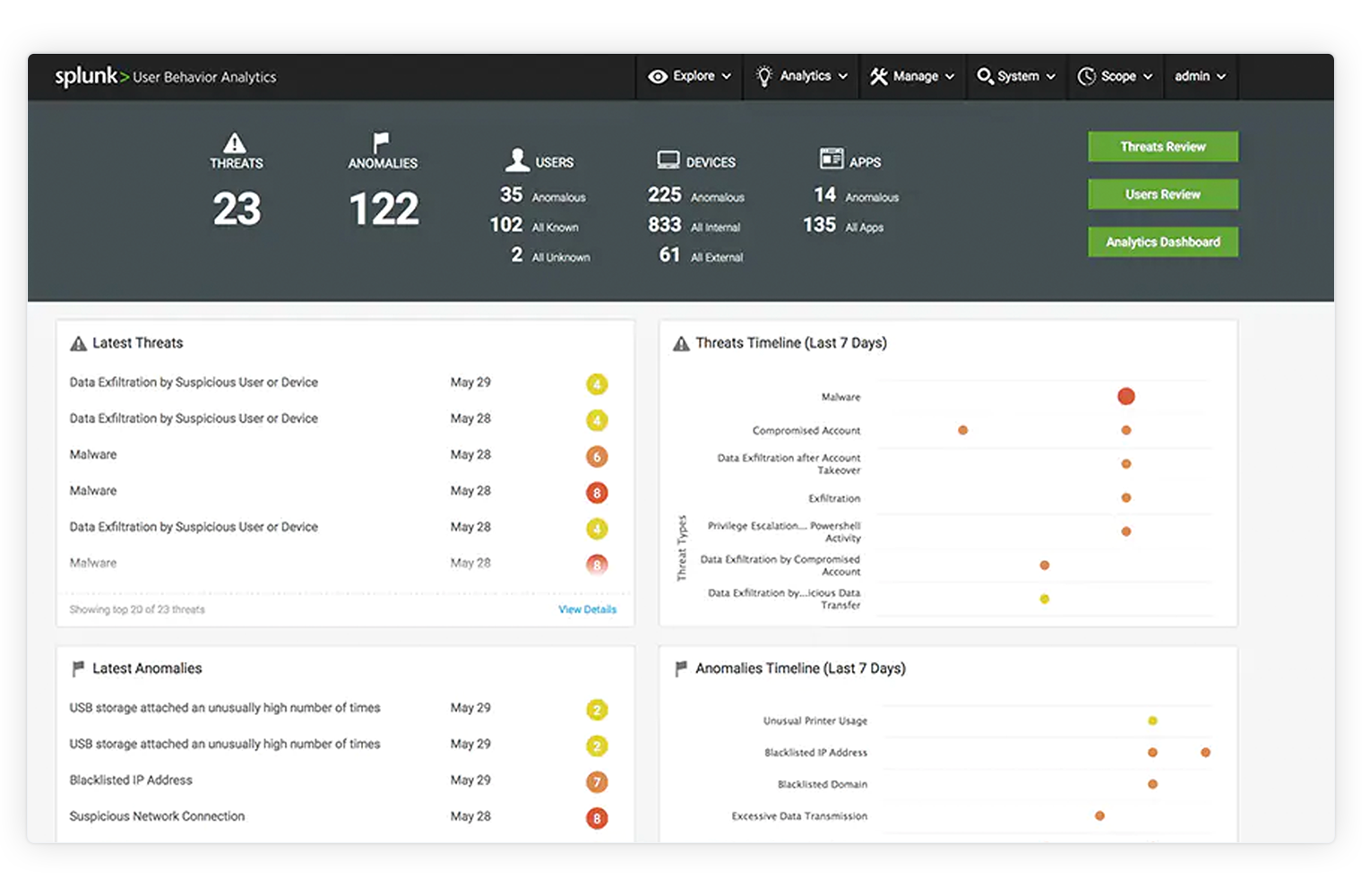
Splunk User Behavior Analytics (UBA) focuses on detecting insider threats and advanced attacks based on user and entity behavior. It looks for patterns across data sources such as login activities, file access, and network traffic.
UBA reduces false positives by correlating events and prioritizing risks based on the context of the behaviors observed such as account takeovers and privilege abuse. By integrating with Splunk ES, UBA intends to help security teams focus on high-priority threats, in the hopes of improving the speed and accuracy of their responses.
Splunk Mission Control
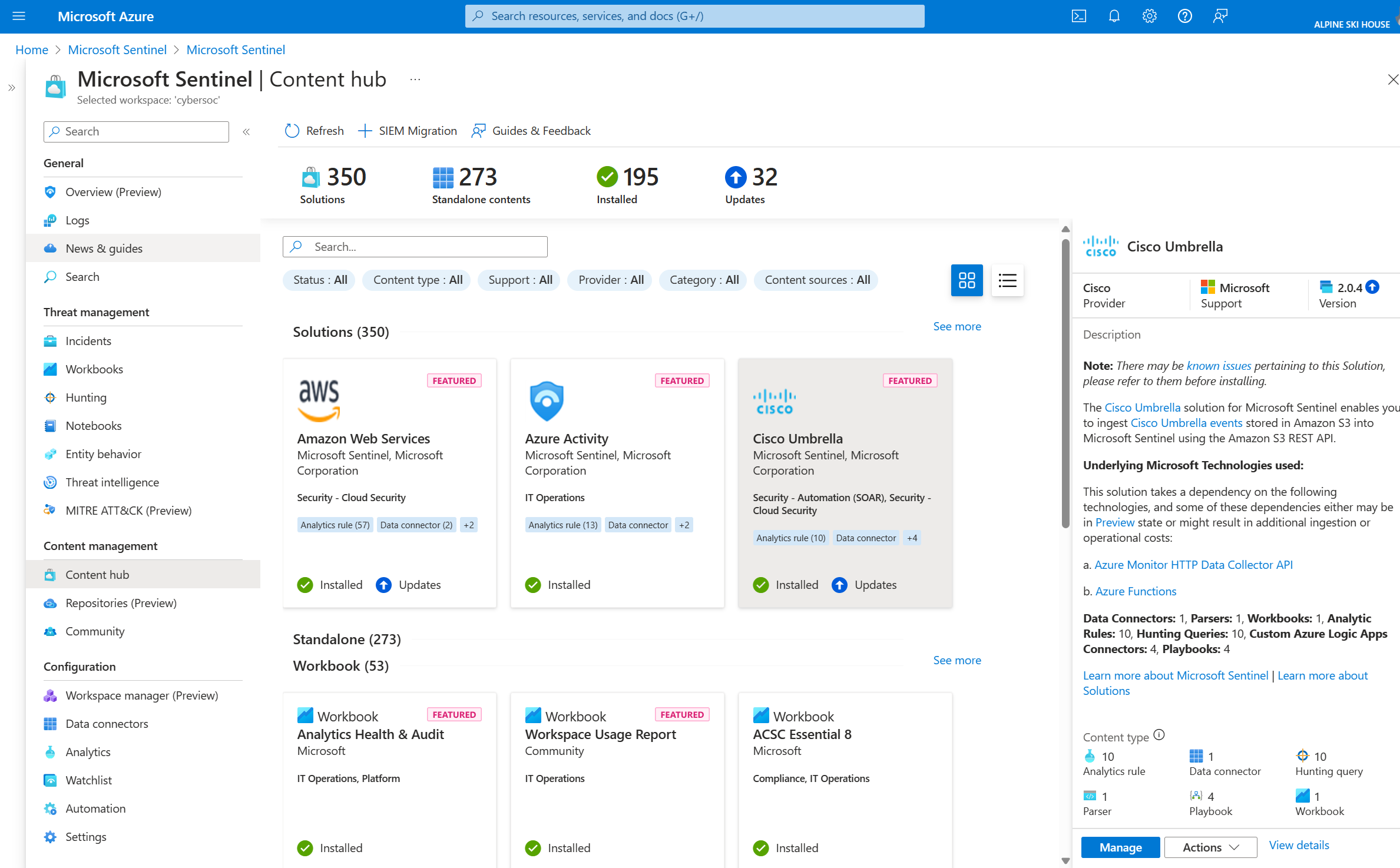
Splunk Mission Control is a feature of Splunk Enterprise Security 8.0 that unifies threat detection, investigation, and response (TDIR) in a single interface. It reduces tool sprawl in security operations centers (SOCs) by consolidating workflows, findings, and response actions into one workspace.
Mission Control provides a centralized Analyst Queue where users can view and prioritize findings. Analysts can triage alerts, manage cases, investigate incidents, and execute response actions without switching between multiple tools. Embedded Splunk search is available directly within the interface, allowing analysts to run queries during investigations without leaving the workflow.
Source: Splunk
Splunk SIEM Pricing Models
Splunk Enterprise Security (ES) offers two pricing models: Workload pricing and ingest pricing. Each model is designed to address an organization’s needs and data usage patterns.
Workload pricing is based on the compute and storage resources required to process data within Splunk. This may be ideal for organizations to want to bring in large amounts of data for future use without worrying about precise ingest volume predictions.
Ingest pricing follows a traditional volume-based approach, charging based on the amount of data ingested into Splunk per day. This model may suit organizations with predictable data strategies and clear use cases.
Choosing the right model:
- Workload pricing is suitable for organizations handling diverse or unpredictable data volumes, offering flexibility and control over compute resources.
- Ingest pricing works best for companies with a clear data strategy and predictable data ingestion needs, ensuring cost-efficiency for well-defined use cases.
Limitations of Splunk SIEM
Splunk Enterprise Security has some limitations that organizations should consider, which may impact its usability, implementation, and cost-effectiveness, particularly for smaller organizations. These limitations were reported by users on the G2 platform:
- High cost at scale: Pricing is commonly based on data ingestion volume, which can become expensive as organizations collect more logs and security telemetry. Costs may increase significantly if data management practices are not optimized.
- Complex implementation process: Initial deployment and onboarding can require significant time, expertise, and resources. Some organizations rely on external consultants or third parties to successfully implement the platform.
- Steep learning curve for analysts: The Search Processing Language (SPL) used for queries and investigations can be challenging for new users. Analysts often need training or prior experience to create advanced queries and customize alerts effectively.
- High infrastructure and resource requirements: On-premises deployments may require substantial compute and storage resources to support large-scale log processing, high availability, and disaster recovery.
- Configuration and tuning effort: Some security use cases require additional customization, rule tuning, or integration with external tools to achieve optimal detection accuracy.
- Performance considerations under heavy load: When processing large volumes of data or complex queries, search performance can slow down unless queries and infrastructure are carefully optimized.
Notable Splunk SIEM Alternatives and Competitors
1. Exabeam

Exabeam is a leading provider of security information and event management (SIEM) solutions, combining UEBA, SIEM, SOAR, and TDIR to accelerate security operations. Its Security Operations platforms enables security teams to quickly detect, investigate, and respond to threats while enhancing operational efficiency.
Key Features:
- Scalable log collection and management: The open platform accelerates log onboarding by 70%, eliminating the need for advanced engineering skills while ensuring seamless log aggregation across hybrid environments.
- Behavioral analytics: Uses advanced analytics to baseline normal vs. abnormal behavior, detecting insider threats, lateral movement, and advanced attacks missed by signature-based systems. Customers report that Exabeam helps detect and respond to 90% of attacks before other vendors can catch them.
- Automated threat response: Simplifies security operations by automating incident timelines, reducing manual effort by 30%, and accelerating investigation times by 80%.
- Contextual incident investigation: Since Exabeam automates timeline creation and reduces time spent on menial tasks, it cuts the time to detect and respond to threats by over 50%. Pre-built correlation rules, anomaly detection models, and vendor integrations reduce alerts by 60%, minimizing false positives.
- SaaS and cloud-native options: Flexible deployment options provide scalability for cloud-first and hybrid environments, ensuring rapid time to value for customers. For organizations who can’t, or won’t move their SIEM to the cloud, Exabeam provides a market-leading, full featured, and self-hosted SIEM.
- Network visibility with NetMon: Delivers deep insight beyond firewalls and IDS/IPS, detecting threats like data theft and botnet activity while making investigation easier with flexible searching. Deep Packet Analytics (DPA) also builds on the NetMon Deep Packet Inspection (DPI) engine to interpret key indicators of compromise (IOCs).
Exabeam customers consistently highlight how its real-time visibility, automation, and productivity tools powered by AI, uplevel security talent, transforming overwhelmed analysts into proactive defenders while reducing costs and maintaining industry-leading support.

2. FortiSIEM

FortiSIEM is a security information and event management platform to support threat detection, investigation, and response within security operations centers. The platform combines event collection, analytics, incident management, and automation to provide visibility across IT and operational technology environments.
Key features include:
- Built-in IT/OT CMDB: Provides automated asset discovery and classification while monitoring asset health and performance across IT and operational technology environments.
- Real-time security analytics: Detects threats using correlation rules, user and entity behavior analytics (UEBA), and customizable machine learning models.
- Built-in SOAR automation: Includes integrated security orchestration and response capabilities with prebuilt playbooks and automation workflows.
- FortiAI-Assist generative AI: Uses generative AI to support investigation, threat hunting, and analyst tasks by providing guided insights and automated assistance.
- OSquery endpoint visibility: Supports endpoint monitoring and forensic investigation through integration with OSquery.
- Broad integrations: Connects with many third-party solutions and security tools while offering deeper integration with Fortinet products.

3. Securonix

Securonix is a cloud-native SIEM platform to unify threat detection, investigation, and response across enterprise environments. The platform integrates analytics, threat intelligence, and automation into a single architecture that processes large volumes of security data. Its design emphasizes behavioral analytics, contextual threat detection, and AI-driven assistance.
Key features include:
- Unified defense SIEM platform: Combines detection, investigation, and response capabilities across multiple data sources within a single cloud-native platform.
- AI-driven anomaly detection: Uses artificial intelligence to analyze behavior patterns and identify suspicious activity based on contextual data.
- Agentic AI assistance: Provides an AI-based SOC analyst that supports tasks such as alert triage, investigation summaries, and response recommendations.
- Automated alert triage and prioritization: Helps reduce alert noise by analyzing signals and highlighting validated risks for analysts.
- Threat intelligence integration: Enriches detections with contextual intelligence aligned with frameworks such as MITRE ATT&CK.
- Prebuilt content and playbooks: Includes predefined detection rules, workflows, and playbooks to accelerate threat detection and response.

Source: Securonix
4. IBM Security QRadar SIEM

IBM Security QRadar SIEM is a security analytics platform that centralizes visibility across security data sources and enables real-time threat detection. The system aggregates logs, network data, and security events to help analysts identify suspicious activity and respond to incidents. QRadar aims to reduce operational overhead by correlating events across environments and providing tools for investigation, compliance monitoring, and threat analysis.
Key features include:
- Centralized security visibility: Aggregates and correlates data from multiple security tools and environments to provide a unified view of events.
- Real-time threat detection: Identifies potential threats by analyzing events and network activity as they occur.
- User behavior analytics: Detects unusual user behavior that may indicate insider threats or compromised accounts.
- Network threat analytics: Monitors network activity to identify anomalies and possible attack patterns.
- Sigma rules support: Enables detection rule creation using the open-source Sigma rule format.
- Integration with existing security tools: Connects with a wide range of security technologies to expand visibility across the environment.

5. Microsoft Sentinel

Microsoft Sentinel is a cloud-native SIEM platform built on Microsoft Azure that provides security monitoring, analytics, and incident response capabilities. The platform collects telemetry from multiple sources and applies analytics, automation, and threat intelligence to help organizations detect and investigate security incidents across hybrid and multi-cloud environments.
Key features include:
- Enterprise-wide visibility: Collects and analyzes security data across users, devices, applications, and infrastructure using hundreds of built-in connectors.
- AI-powered threat detection: Uses analytics, machine learning, and Microsoft threat intelligence to identify suspicious activity and potential attacks.
- Integrated SOAR capabilities: Automates security workflows and incident response processes through built-in orchestration and automation tools.
- Security data lake architecture: Centralizes security data storage to support analytics, threat detection, and long-term data analysis.
- Graph-powered investigation tools: Provides relationship mapping between entities and events to help analysts investigate incidents.
- Generative AI security assistance: Uses AI tools such as Security Copilot to summarize incidents, generate queries, and recommend response actions.

6. Elastic Security

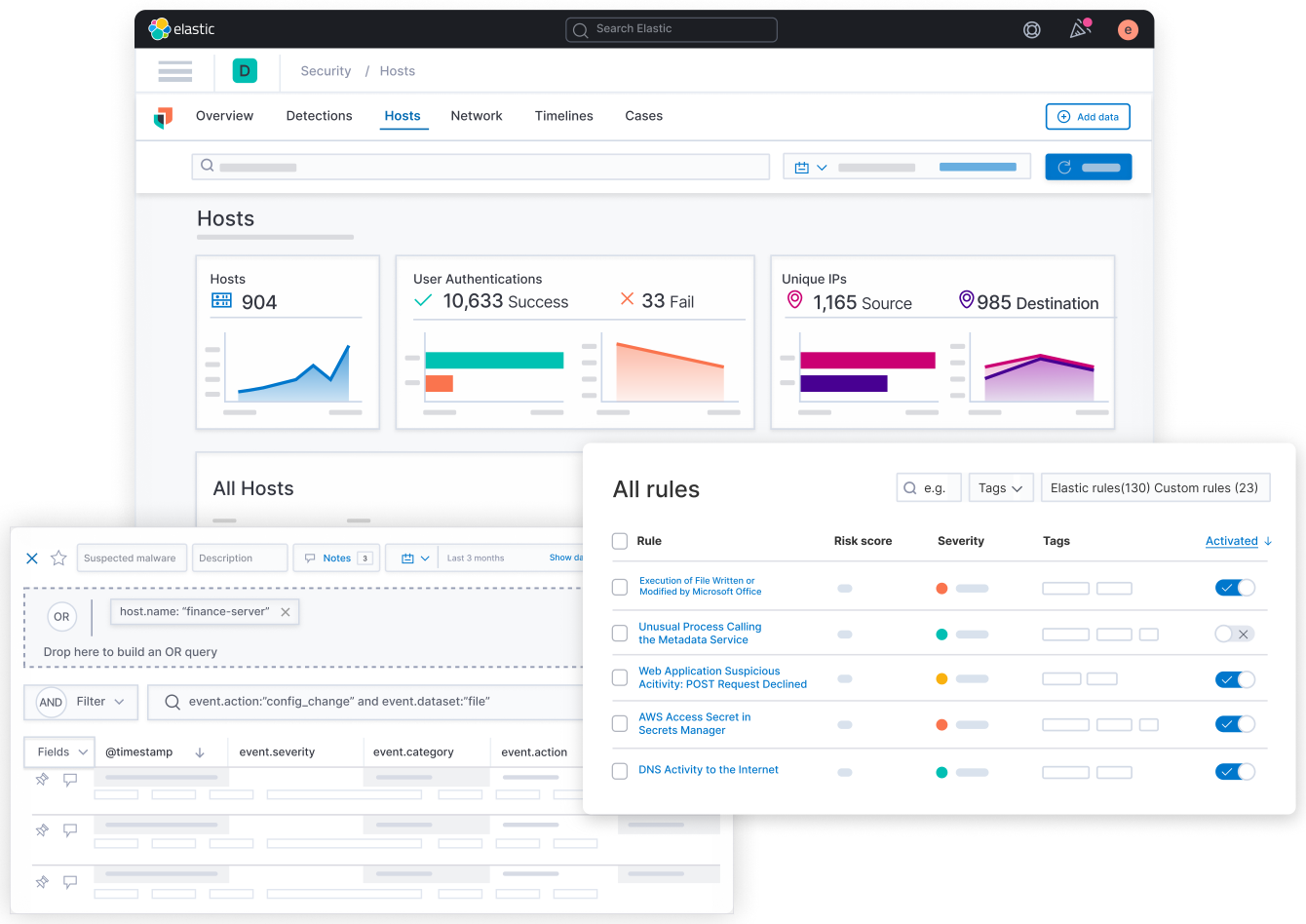
Elastic Security is a SIEM platform built on the Elasticsearch ecosystem that enables organizations to detect, investigate, and respond to cyber threats using centralized data analytics. The platform integrates security analytics, endpoint visibility, and automation into a single environment to support security operations workflows.
Key features include:
- Unified SIEM and XDR capabilities: Combines SIEM, endpoint protection, and cloud security capabilities within a single platform.
- AI-driven threat detection: Uses machine learning and analytics to identify anomalous activity and potential attacks.
- Open detection rules: Provides open-source detection rules that can be inspected and customized by security teams.
- Cross-environment data visibility: Collects and analyzes data from cloud, on-premises, and hybrid environments.
- Generative AI investigation assistance: Supports analysts with AI tools that help with triage, investigation, and response workflows.
- Federated search across data sources: Enables analysts to query large volumes of structured and unstructured data across distributed environments.

Conclusion
Splunk SIEM is a tool addressing the growing complexity of cyber threats through analytics, machine learning, and automation. By integrating diverse data sources, streamlining workflows, and enhancing threat detection capabilities, such platforms intend to empower security teams to respond more effectively to incidents. However, organizations must carefully evaluate their needs, technical resources, and budget to ensure the chosen solution aligns with their operational goals and provides a sustainable security strategy.
See Additional Guides on Key Managed Services Topics
Together with our content partners, we have authored in-depth guides on several other topics that can also be useful as you explore the world of managed services.
CDN
Authored by Imperva
- [Guide] What is Anycast Routing | Anycast DNS | CDN Guide
- [Guide] What is Image Optimization | Image Compression and Loading
- [Blog] The New York Times vs. OpenAI: A Turning Point for Web Scraping?
- [Product] Imperva Secure CDN | Fast and Secure Content Delivery Network
What is Cloud Hosting
Authored by Atlantic
- [Guide] What Is Cloud Hosting? | Cloud Hosting Defined & Explained
- [Guide] What is MSSQL? About Microsoft SQL Server
- [Blog] 9 Essential Features of Dedicated Server Hosting
- [Product] Atlantic.Net Dedicated Server Hosting
AWS Database
Authored by NetApp
Learn More About Exabeam
Learn about the Exabeam platform and expand your knowledge of information security with our collection of white papers, podcasts, webinars, and more.